
Setting up your brand kit includes a logo, color scheme and fonts. By having a brand kit that encompasses these elements, it allows your company to create continuity. The same colors and fonts should be used on all your marketing materials including your website and other electronic media and any print marketing materials. Choosing the right font for your brand is crucial as it plays a significant role in conveying your brand’s personality, values, and overall message.

Here’s a guide to help you make an informed decision:
1. Understand Your Brand’s Personality
Before diving into font options, define your brand’s core identity. Ask yourself:
- What is your brand’s mission and vision?
- What emotions do you want to evoke in your audience?
- Who is your target audience? (e.g., young and modern, mature and sophisticated, playful, serious, luxurious, accessible)
- What are your brand’s core values?
For example, a luxury brand might lean towards elegant serifs, while a playful brand might opt for a rounded sans-serif or a handwritten font.
2. Research Font Categories
Fonts are generally categorized into a few main types, each with its own characteristics:
- Serif Fonts: Have small decorative strokes (serifs) at the end of each letter. They often convey tradition, sophistication, reliability, and respectability. Examples: Times New Roman, Georgia, Garamond.
- Sans-Serif Fonts: Lack serifs, resulting in a cleaner, more modern look. They are often associated with simplicity, modernity, professionalism, and approachability. Examples: Helvetica, Arial, Open Sans.
- Script Fonts: Mimic handwriting or calligraphy. They can convey elegance, creativity, personal touch, or a sense of luxury. Use sparingly, as they can sometimes be difficult to read. Examples: Pacifico, Great Vibes.
- Display Fonts: Designed for large headlines and often have unique, decorative styles. They are meant to grab attention but are generally not suitable for long blocks of text due to readability concerns. Examples: Anton, Lobster.
- Monospace Fonts: Each character occupies the same amount of horizontal space. Often used for coding, technical documentation, or to evoke a retro, typewriter feel. Examples: Courier New, Roboto Mono.
3. Consider Readability and Legibility
The most beautiful font is useless if it’s not readable.
- Readability: How easy it is to read large blocks of text. Factors include line spacing, letter spacing, and paragraph alignment.
- Legibility: How easy it is to distinguish individual characters from each other. Important for headlines, logos, and short bursts of text.
Test your chosen font across different sizes and platforms (web, print, mobile) to ensure it performs well in all contexts.
4. Explore Font Pairings
Rarely will a single font fulfill all your brand’s typographic needs. Effective font pairing involves combining two or more fonts that complement each other while serving different purposes (e.g., a headline font and a body text font).
- Contrast: Pair fonts with contrasting characteristics (e.g., a strong sans-serif headline with a classic serif body text).
- Harmony: Ensure the chosen fonts don’t clash. They should visually support each other.
- Limit: Stick to 2-3 fonts to avoid a cluttered or inconsistent look.
5. Test and Refine
Once you’ve narrowed down your choices, create mockups of your brand’s identity using the selected fonts. Apply them to:
- Your logo
- Website headers and body text
- Marketing materials (brochures, social media graphics)
- Business cards
Gather feedback from your target audience if possible. Sometimes a font that looks great in isolation might not translate well in a full brand context.
6. Consider Licensing
Before finalizing your font choice, understand its licensing terms. Some fonts are free for personal and commercial use (e.g., Google Fonts), while others require a paid license. Ensure you have the appropriate rights to use the font for all your brand’s applications. By carefully considering these factors, you can choose a font that not only looks appealing but also effectively communicates your brand’s essence and resonates with your audience.
The team at Creative Stories Media located in Southern California can guide you through the process of choosing a font for your brand kit.
 Creative Stories Media
https://creativestoriesmedia.com/wp-content/uploads/2025/09/videography-029-1.jpg
1080
1920
Rachel Bollin
https://creativestoriesmedia.com/wp-content/uploads/2025/07/creative-storeis-media-header-logo-2025.png
Rachel Bollin2025-09-24 16:23:542025-09-24 16:23:54Telling the Brand Story
Creative Stories Media
https://creativestoriesmedia.com/wp-content/uploads/2025/09/videography-029-1.jpg
1080
1920
Rachel Bollin
https://creativestoriesmedia.com/wp-content/uploads/2025/07/creative-storeis-media-header-logo-2025.png
Rachel Bollin2025-09-24 16:23:542025-09-24 16:23:54Telling the Brand Story Creative Stories Media
https://creativestoriesmedia.com/wp-content/uploads/2025/07/07-28-25_logo_annc_06.png
1250
1000
Rachel Bollin
https://creativestoriesmedia.com/wp-content/uploads/2025/07/creative-storeis-media-header-logo-2025.png
Rachel Bollin2025-08-19 18:41:032025-09-04 08:29:23Overcoming Obstacles in Business
Creative Stories Media
https://creativestoriesmedia.com/wp-content/uploads/2025/07/07-28-25_logo_annc_06.png
1250
1000
Rachel Bollin
https://creativestoriesmedia.com/wp-content/uploads/2025/07/creative-storeis-media-header-logo-2025.png
Rachel Bollin2025-08-19 18:41:032025-09-04 08:29:23Overcoming Obstacles in Business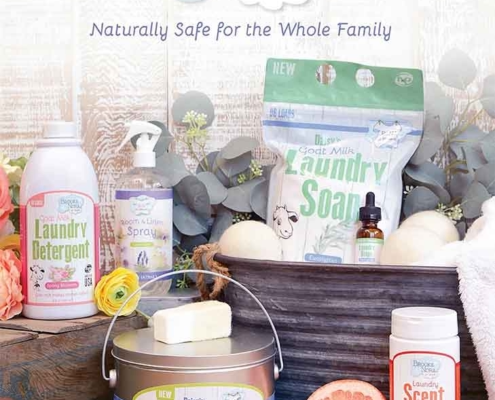 https://creativestoriesmedia.com/wp-content/uploads/2025/05/brooke-nora-laundry-products-011.avif
972
729
Rachel Bollin
https://creativestoriesmedia.com/wp-content/uploads/2025/07/creative-storeis-media-header-logo-2025.png
Rachel Bollin2025-07-21 02:34:542025-07-31 16:27:29Print Marketing Materials Remain Valuable
https://creativestoriesmedia.com/wp-content/uploads/2025/05/brooke-nora-laundry-products-011.avif
972
729
Rachel Bollin
https://creativestoriesmedia.com/wp-content/uploads/2025/07/creative-storeis-media-header-logo-2025.png
Rachel Bollin2025-07-21 02:34:542025-07-31 16:27:29Print Marketing Materials Remain Valuable
